
Quick answer
Yes — solar panels are recyclable. Around 95% of a standard panel by weight is made of recoverable materials, mainly glass, aluminium and silicon. The catch is capacity: Australia is only now building the facilities and rules to recycle panels at scale, so today most removed panels are still sent to landfill. If you have panels in Sydney, the realistic path is to have them collected and then assessed for reuse or recycling rather than binned.
Are solar panels recyclable?
A crystalline-silicon panel is mostly glass and an aluminium frame, with a thin layer of silicon cells and small amounts of copper and silver. According to the Clean Energy Council, about 95% of a panel’s materials can be recycled. The barrier has never really been whether panels can be recycled — it is whether there is nearby capacity to do it economically.
| Material | Share (approx.) | Recovered for |
|---|---|---|
| Glass | ~70% | New glass, aggregate |
| Aluminium frame | ~10–15% | Remelted aluminium |
| Polymer / encapsulant | ~10% | Energy recovery / processing |
| Silicon cells | ~3–5% | Silicon, silver, copper |
| Metals (Cu, Ag) | <1% | High-value metal recovery |
What actually happens now
The volume is significant and growing. Research from UNSW and the Australian Centre for Advanced Photovoltaics, cited by the Australian Energy Council, projects Australia’s cumulative end-of-life solar waste at around 685,000 tonnes by 2030 and about 1.16 million tonnes by 2035, with a recoverable material value above A$1 billion. Despite that value, the majority of removed panels are still landfilled today because collection and recycling infrastructure is still catching up.
What’s changing in 2026
Policy is moving. In January 2026 the federal government announced a national solar panel recycling pilot — funding collection sites around the country to test real-world collection, transport and recycling and to inform a future mandatory product-stewardship scheme. New South Wales is helping lead the interjurisdictional work on that national scheme. These programs are still being finalised, so treat specific thresholds and timelines as evolving rather than fixed.
Recycling vs reuse
Recycling and reuse are not the same. Recycling breaks a panel down to recover materials; reuse keeps the whole panel working. For panels in sound condition, reuse is usually the better outcome because it keeps more value and avoids reprocessing — so a responsible collector assesses each panel first. We cover this in detail in second-life solar.
How to recycle old solar panels in Sydney
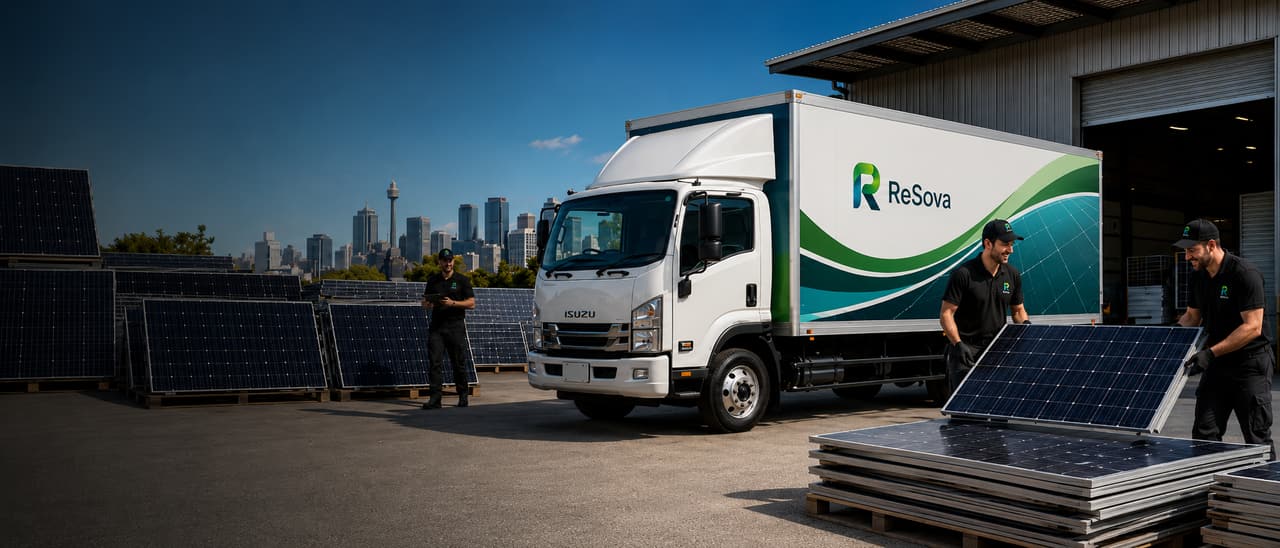
For Sydney homes, electricians and businesses, the practical route is on-site collection. ReSova collects removed panels, documents the pickup, and sorts them by condition — sound panels are assessed for reuse and the rest are directed to recycling or recovery. Check what we can take on the what we collect page, or get an indicative price with the online estimator.
Key takeaways
- About 95% of a solar panel's materials are recyclable, but most removed panels in Australia are still landfilled.
- Australia is heading toward roughly 1 million tonnes of panel waste by 2035, which is driving new recycling capacity and policy.
- A national recycling pilot and product-stewardship scheme are being developed, led in part by NSW.
- Reuse is considered before recycling for sound panels; damaged panels are recycled.
- In Sydney, the practical route is on-site collection, then assessment for reuse or recycling.
Frequently asked questions
Are solar panels recyclable in Australia?
Yes. About 95% of a standard photovoltaic panel by weight is recyclable — mainly glass, aluminium framing and silicon, plus smaller amounts of copper and silver. A growing number of Australian facilities can recover these materials, though capacity is still limited relative to the incoming volume.
How much does it cost to recycle solar panels?
There is usually a handling and transport cost, because recovering materials from panels is labour-intensive and most panels must be collected and transported first. For Sydney collections, ReSova prices from the panel quantity, postcode and site access — you can get an indicative figure from the online estimator.
Can broken or damaged solar panels be recycled?
Yes. Damaged panels are generally directed to recycling rather than reuse. Shattered, fire-affected or contaminated panels should be disclosed before collection so they can be handled safely.
Is it better to recycle or reuse an old solar panel?
Reuse keeps more value and avoids reprocessing, so panels in sound working condition are assessed for reuse first. Recycling is the right pathway for panels that are damaged, underperforming or genuinely at end of life.
See what we collect
ReSova collects old solar panels on site across Sydney, then sorts them for reuse or recycling. Check coverage and pricing for your postcode, or talk to the team.