
Quick answer
It depends on which classification you mean. Standard crystalline-silicon solar panels — the vast majority installed in Australia — are not classified as hazardous waste under normal handling; any lead in the solder is a trace amount sealed inside glass and polymer. But panels are still broadly treated as e-waste in practice: several states restrict them from landfill, and the federal government has proposed formally including solar panels in the statutory definition of “regulated e-waste.” The practical answer is to treat removed panels as e-waste regardless of the technical hazard label, and have them collected for reuse or recycling rather than binned.
Why the answer isn’t a simple yes or no
“Is it hazardous?” and “is it e-waste?” are two different questions. Hazard classification looks at what a panel is actually made of and whether it can leach or harm health and the environment. E-waste classification is about category — electronic and electrical equipment at end of life — regardless of how hazardous its specific materials are. A panel can be low-hazard by content and still be regulated as e-waste simply because it’s decommissioned electronic equipment. Both answers can be true at once.
What’s actually inside a panel
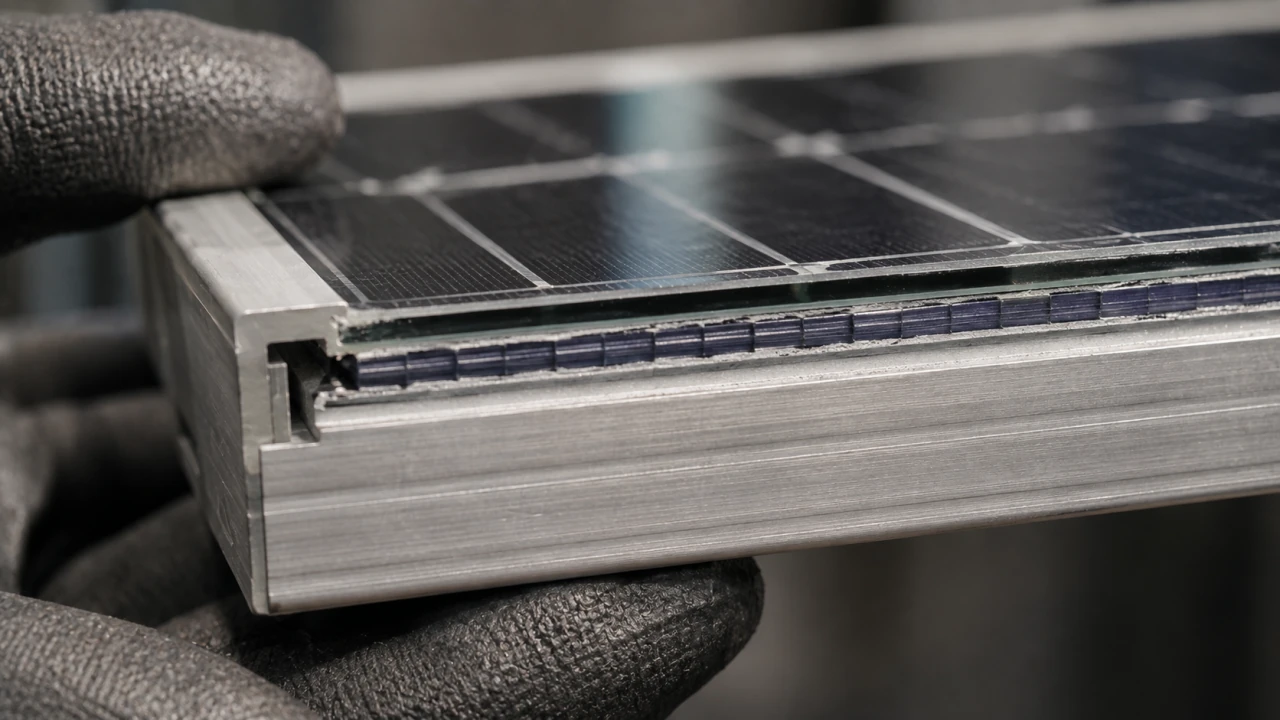
Most panels installed in Australia are crystalline silicon. According to industry and technical sources, commercially available crystalline-silicon panels typically contain trace amounts of lead — usually under 0.1% by weight — used in cell soldering, and this is enclosed within non-porous glass and polymer layers rather than exposed. Thin-film cadmium telluride (CdTe) panels, which are uncommon in Australian rooftop solar, contain a stable cadmium compound at a similarly low weight fraction. Neither material profile is unique to solar — many household electronics contain comparable trace metals.
| Panel type | Common in Australia? | Notable material | Typical classification |
|---|---|---|---|
| Crystalline silicon (mono/poly) | Yes — the large majority of installs | Trace lead in solder (commonly <0.1% by weight), sealed in glass/polymer | Not classified as hazardous waste under normal handling |
| Thin-film (CdTe) | Rare in Australian rooftop solar | Cadmium telluride compound (commonly <0.1% cadmium by weight) | Draws more regulatory scrutiny; treated with more caution |
Why panels are treated as e-waste anyway
Even where a panel isn’t formally hazardous, it’s still decommissioned electronic equipment, and Australia is moving to regulate it that way. Solar panels have been on the federal government’s product stewardship priority list since 2017, and DCCEEW has funded a national solar panel recycling pilot to test collection and recycling ahead of a future scheme. A coalition of 60 industry, union, local government and environmental organisations — including the Smart Energy Council — is publicly pushing for a mandatory product stewardship scheme, noting that less than 5% of decommissioned panels are currently recycled despite more than 95% of a panel’s materials being recoverable.
Why landfill rules follow from this
Because panels are treated as e-waste in practice, several states already restrict or ban them from general landfill, independent of any formal hazardous-waste finding — it’s the e-waste category, not a hazard rating, driving those bans. Rules differ by state and are changing; we cover the current state-by-state position in solar panels and landfill rules.
What this means for businesses
Commercial and construction waste generally carries a duty of care, regardless of a formal hazard classification: you’re expected to use a legitimate recovery pathway and be able to show where the waste went. For a site removing panels, that means using a collector who documents the pickup rather than mixing panels into general skip waste. ReSova records every collection on a job docket for exactly this reason.
What’s changing
Policy is moving on two fronts at once: the proposed inclusion of solar panels in the statutory “regulated e-waste” definition, and the push for a mandatory product stewardship scheme funded by manufacturers and importers rather than councils or consumers. Neither is legislated yet, so treat specific thresholds and timelines as evolving rather than fixed — the safe assumption today is that panels should be handled as e-waste either way.
The practical answer for Sydney
Whatever the formal classification, the practical path is the same: don’t landfill removed panels. ReSova collects panels in Sydney, documents the pickup and sorts by condition for reuse or recycling. Check what we can take on the what we collect page, or get an indicative price with the online estimator.
Key takeaways
- Standard crystalline-silicon panels aren't classified as hazardous waste under normal handling — trace lead in the solder is sealed inside glass and polymer.
- Panels are still broadly treated as e-waste in practice, which is a category classification, not a hazard rating.
- Solar panels have been on Australia's federal product stewardship priority list since 2017; a national recycling pilot is under way.
- Less than 5% of decommissioned panels are currently recycled, despite over 95% of materials being recoverable.
- State landfill restrictions on panels stem from e-waste classification, not a formal hazardous-waste finding — the practical answer is to treat panels as e-waste regardless.
Frequently asked questions
Are solar panels classified as hazardous waste in Australia?
Generally no for standard crystalline-silicon panels under normal handling — any lead in the solder is a trace amount (typically under 0.1% by weight) sealed inside glass and polymer, and isn't classified as hazardous waste. Thin-film cadmium telluride panels, which are uncommon in Australian rooftop installs, draw more scrutiny for their cadmium content.
Are solar panels e-waste?
In practice, yes — panels are widely treated as electronic waste for disposal purposes, even though the formal 'regulated e-waste' statutory definition is still being updated federally. Several states already restrict solar panels from landfill on that basis.
Do businesses have extra obligations when disposing of solar panels?
Commercial and construction waste generally carries a duty of care to use a legitimate recovery pathway and be able to show where the waste went. Using a collector who documents the pickup on a job docket is the practical way to meet that.
Will solar panels be covered by a mandatory recycling scheme?
Solar panels have been on the federal product stewardship priority list since 2017, and a coalition of 60 industry, union and community organisations is pushing for a mandatory scheme. A national funded pilot is under way, but a mandatory scheme is not yet legislated — treat this as evolving rather than fixed.
See what we collect
ReSova collects old solar panels on site across Sydney, then sorts them for reuse or recycling. Check coverage and pricing for your postcode, or talk to the team.